

Sunday, July 2, 2017


Tuesday, January 13, 2015
2014 in Review
I can't explain why I quit blogging this year. It was not a concious decision and it was not because I was too busy, that's for sure. Maybe I've just been in Korea too long and even the really exciting things that I did just didn't seem that exciting. Who knows? So, I'm going to sum up my year in one post, and hopefully I'll get around to actually finishing it and posting it. Maybe in the new year I'll start blogging again. Maybe. I do miss it sometimes.
All of these points need at least 1 blog post, some of them need at least 3. This is the best I can do for now, who knows, maybe I'll find some motivation in the future...

From Jan 10-Feb 24th I was in India teaching at a Buddhist monastery in northern India. It was a really interesting time and I learned a lot as a teacher, and a person. I also learned about the importance of health, as I came down with hepatitis shortly after I came home and was basically incapacitated for a few days and really needed more than a month to recover properly.
After returning from India (and just around the time I came down with hep) I started work a university here in Seoul. I won't say the name for privacy reasons, but it's a really great school to work for. The location is not the best, but it's manageable, and when you're only teaching 14 hours a week 45min-1hr commute is not TOO bad. I'm not quite sure why, but the administration seems to like me at this school and not only have they renewed my contract for the next year, but they are promoting me to level coordinator. I worry I will be a huge disappointment, but we'll see what the next semester brings...

In May we rode our bikes following the 4 rivers bike path. Our original plan was to get to Busan, but bike problems + laziness + out of shapeness only brought us to Andong. It was still a fantastic ride and conquring the Saejae bike path through the mountains was probably one of the proudest moments of my life.

Also in May, two of my good friends got married. I really liked their wedding because they took all the western and Korean traditions and mixed them all up together in their own way. And my friend got spanked on the feet with a dried fish.

I tried a bit harder this year to study more 'academic' Korean. I found this fantastic leveled reader series of Korean books and I've now read three of them. they're not long, and they're not hard, but they give you confidence to try harder things. I also read 1/3 of The Diary of Anne Frank and am now reading/translating a book on Korean culture.
I also took 1 semester of intensive Korean (level 4) at Sungkyunkwan Univeristy over the summer, and then discovered that the university where I work offers intensive Korean classes at 70% discount, so in the fall and winter semesters, I continued with level 5 and 6. Considering I was working at the same time, it was kind of a disaster, and I can't say that I have learned much, but it's better than nothing, and the price was too good to turn down. This weekend I will take the TOPIK exam again. I'm hoping for level 4 (cross fingers).

In June we did a 3 night trip around Ganghwado by bike. It was really fantastic, though I regret a little veering off to another smaller island for 1 night. It was more expencive and there was no good food to be found. Ganghwado is big enough and exciting enough, it's not really necessary to go to other islands on such a short trip.

At the end of June I went to visit my friends in Hong Kong. They've been living there for 2 years and I have never managed to find time to visit. I finally made it. Besides being veryhot fun to see Hong Kong in the summer, and good to see my friends, it was also some of the best time I've ever had to practice Korean. I literally spent 5 days only speaking Korean. I was really starting to function in Korean. As an English teacher here, even though I speak Korean fairly well, I'm always using English for this or that, if not for work than with friends, if not with friends than with my husband. etc. etc. In Hong Kong, staying with two Koreans, there was almost no reason to use English. Finally on the last day we met a friend of my friend and had to switch to English since he was British. We both laughed because we thought the sound of our English speaking was too strange.
In early July I bought my first smartphone. Sometimes I wish I hadn't, but sometimes it really is handy. I do miss daydreaming sometimes. I try to remember to do it sometimes, but the NPR articles that keep popping up on my Facebook newsfeed are just too interesting ㅠㅠ.

In early August we took a few nights trip to Qingtao (now my 2nd time to visit, but I haven't blogged about either time) to visit the husband's sister and brother-in-law. The Koreans went and played a lot of golf, and I explored the city. Qingtao is a really fantastic city, but since I'd already been there once I had already seen all the cool stuff. I just tried my best to enjoy the good food. Here is the family at the Tsingtao Brewery.
Throughout the summer, the husband and I worked on a DMZ bike trip project. We never had enough time to do it straight through, so we had to do it in 3 parts. There's no bike paths up there, and there are a ton of pretty big mountains. But, the nice thing is that there are not many people/ cars and you can see a lot of military bases. It's hard to follow maps up there because even if you look at the map and you see a road, that doesn't mean that non-military/residents are allowed to use it. Sometimes we would ride along a road for 10 km only to be told somewhere in the middle that we could not pass and we had to turn back and find another road. It's truly an adventure. A frustrating, wonderful adventure.

In October I bought a new bike and we took our bikes down to Jeju Island for a bike tour. We did the whole island in 4 days. The first day was fantastic, the second day was ok but a little windy with sunny skies. The third day was cloudy and overcast with serious headwinds and a few bike issues. The fourth day was full on typhoon winds and some rain from a big typhoon hitting Japan at the time. It was hard, but certainly an accomplishment. I just wish that the salt water hadn't rusted my brand new bike up...

Two weeks later we went with the husband's little brother and sister to Tokyo for a 2 night, 3 day trip. It was a fun trip, maybe more fun because we were with two high school kids, one of which is a total otaku who could speak Japanese fairly well. The most fun/interesting/strange experience was going to a maid cafe. We new it would be expencive, but $80 for 4 people was a little rough. We realized that the table fee for our seats was much higher... if we had sat on the other side of the room at a counter style table, the table fee would have been much cheaper. I'm not sure what to make of the whole maid cafe thing, but at least I can say I've seen/done it, whether it's a good thing or not I don't know.
Two more friends got married in November. Two weeks before the wedding we delivered a 함. This is a Korean wedding tradition which is quickly disappearing, at least partially due to the fact that most Koreans live in apartments and delivering a 'ham' is a very noisy affair which involves a lot of fighting and negotiating and singing and drinking etc. I really need to write a long blog post about this, since there's not much information on the internet in English, but in the meantime, watch this video and ask your Korean friends about what 함 is.
 Then they got married a few weeks later. Traditional weddings mean more excuses for me to wear my hanbok. It was a really nice wedding and they were really fortunate because despite being the end of November, it was not cold at all.
In December we started the new ski season. So far for this season we've already put in 12 or 13 days of skiing thanks to two 4 day weekends with Christmas and New Years. My skiing is getting better and better, but I've still got a long way to go to look as graceful as some other skiers on the mountain.
What is in store for 2015? In the very immediate future, I'm leaving for a 3 week trip home to Boston and I've planned a mother-daughter trip to the Florida Keys for a week. After ski season is done I hope to do even more bike trips this year. I'd like to do a little more world travel next summer... maybe with the bike? But, beyond that trying not to over-plan because my schedule has been busy enough these days.
All of these points need at least 1 blog post, some of them need at least 3. This is the best I can do for now, who knows, maybe I'll find some motivation in the future...
From Jan 10-Feb 24th I was in India teaching at a Buddhist monastery in northern India. It was a really interesting time and I learned a lot as a teacher, and a person. I also learned about the importance of health, as I came down with hepatitis shortly after I came home and was basically incapacitated for a few days and really needed more than a month to recover properly.
After returning from India (and just around the time I came down with hep) I started work a university here in Seoul. I won't say the name for privacy reasons, but it's a really great school to work for. The location is not the best, but it's manageable, and when you're only teaching 14 hours a week 45min-1hr commute is not TOO bad. I'm not quite sure why, but the administration seems to like me at this school and not only have they renewed my contract for the next year, but they are promoting me to level coordinator. I worry I will be a huge disappointment, but we'll see what the next semester brings...
In May we rode our bikes following the 4 rivers bike path. Our original plan was to get to Busan, but bike problems + laziness + out of shapeness only brought us to Andong. It was still a fantastic ride and conquring the Saejae bike path through the mountains was probably one of the proudest moments of my life.
Also in May, two of my good friends got married. I really liked their wedding because they took all the western and Korean traditions and mixed them all up together in their own way. And my friend got spanked on the feet with a dried fish.
I also took 1 semester of intensive Korean (level 4) at Sungkyunkwan Univeristy over the summer, and then discovered that the university where I work offers intensive Korean classes at 70% discount, so in the fall and winter semesters, I continued with level 5 and 6. Considering I was working at the same time, it was kind of a disaster, and I can't say that I have learned much, but it's better than nothing, and the price was too good to turn down. This weekend I will take the TOPIK exam again. I'm hoping for level 4 (cross fingers).
In June we did a 3 night trip around Ganghwado by bike. It was really fantastic, though I regret a little veering off to another smaller island for 1 night. It was more expencive and there was no good food to be found. Ganghwado is big enough and exciting enough, it's not really necessary to go to other islands on such a short trip.
At the end of June I went to visit my friends in Hong Kong. They've been living there for 2 years and I have never managed to find time to visit. I finally made it. Besides being very
In early July I bought my first smartphone. Sometimes I wish I hadn't, but sometimes it really is handy. I do miss daydreaming sometimes. I try to remember to do it sometimes, but the NPR articles that keep popping up on my Facebook newsfeed are just too interesting ㅠㅠ.
In early August we took a few nights trip to Qingtao (now my 2nd time to visit, but I haven't blogged about either time) to visit the husband's sister and brother-in-law. The Koreans went and played a lot of golf, and I explored the city. Qingtao is a really fantastic city, but since I'd already been there once I had already seen all the cool stuff. I just tried my best to enjoy the good food. Here is the family at the Tsingtao Brewery.
Throughout the summer, the husband and I worked on a DMZ bike trip project. We never had enough time to do it straight through, so we had to do it in 3 parts. There's no bike paths up there, and there are a ton of pretty big mountains. But, the nice thing is that there are not many people/ cars and you can see a lot of military bases. It's hard to follow maps up there because even if you look at the map and you see a road, that doesn't mean that non-military/residents are allowed to use it. Sometimes we would ride along a road for 10 km only to be told somewhere in the middle that we could not pass and we had to turn back and find another road. It's truly an adventure. A frustrating, wonderful adventure.
In October I bought a new bike and we took our bikes down to Jeju Island for a bike tour. We did the whole island in 4 days. The first day was fantastic, the second day was ok but a little windy with sunny skies. The third day was cloudy and overcast with serious headwinds and a few bike issues. The fourth day was full on typhoon winds and some rain from a big typhoon hitting Japan at the time. It was hard, but certainly an accomplishment. I just wish that the salt water hadn't rusted my brand new bike up...
Two weeks later we went with the husband's little brother and sister to Tokyo for a 2 night, 3 day trip. It was a fun trip, maybe more fun because we were with two high school kids, one of which is a total otaku who could speak Japanese fairly well. The most fun/interesting/strange experience was going to a maid cafe. We new it would be expencive, but $80 for 4 people was a little rough. We realized that the table fee for our seats was much higher... if we had sat on the other side of the room at a counter style table, the table fee would have been much cheaper. I'm not sure what to make of the whole maid cafe thing, but at least I can say I've seen/done it, whether it's a good thing or not I don't know.
Two more friends got married in November. Two weeks before the wedding we delivered a 함. This is a Korean wedding tradition which is quickly disappearing, at least partially due to the fact that most Koreans live in apartments and delivering a 'ham' is a very noisy affair which involves a lot of fighting and negotiating and singing and drinking etc. I really need to write a long blog post about this, since there's not much information on the internet in English, but in the meantime, watch this video and ask your Korean friends about what 함 is.
In December we started the new ski season. So far for this season we've already put in 12 or 13 days of skiing thanks to two 4 day weekends with Christmas and New Years. My skiing is getting better and better, but I've still got a long way to go to look as graceful as some other skiers on the mountain.
What is in store for 2015? In the very immediate future, I'm leaving for a 3 week trip home to Boston and I've planned a mother-daughter trip to the Florida Keys for a week. After ski season is done I hope to do even more bike trips this year. I'd like to do a little more world travel next summer... maybe with the bike? But, beyond that trying not to over-plan because my schedule has been busy enough these days.
Sunday, May 25, 2014
Bike Ride from Yangpyong to Andong

Over the long weekend several weeks ago, a few friends and I attempted to ride from just outside of Seoul in Yangpyong to Busan. We were the only two who didn't have to work, so we got an early start on the trip on Friday. Here we are at the start of the trip on Friday morning at 9:00am, ready to go!

About 1km into our journey we hit a bump and my friend got a pinched flat. Here he is, looking not so happy about it.

Fortunately we were prepared and, and we were able to patch the tire in 30 minutes flat (haha, pun intended), And we thought we were ready to continue our ride.

A minute later we realized that not only had he gotten a flat, but had also damaged his pedal crank. We did a quick Google search to find the nearest bike shop to fix it. Unfortunately he pedal crank had to be replaced, but the only option this bike shop had was a steel one. It was quite heavy, but it was cheap, so we had them put it on and continued along the journey.

We made it to within sight of Ipobo before the new pedal crank was now wobling like the first one. Unfortunately, there were no bike shops out here as it was much more rural than Yangpyong. We had no idea how to fix it and we had ti figure out a way to get to Yeoju, then next city. We thought maybe we could somehow get the bikes into a taxi. Upon asking a local for the phone number for the local taxi company, he laughed at our notion of getting two bikes in a taxi and suggested that he could take us in his Bongo truck... for 50,000 won. While it was steep, we didn't know any other way, so we bargained our fare down to 40,000 won and he drove us the remaining 15-20km to Yeoju. In Yeoju we were able to get a better steel alloy pedal crank for his bike, but at this point we were quite frustrated and it was getting a bit late in the day to continue on to the next big city, Chungju. We settled down for the night an grabbed a motel and waited for two others to join us there in Yeoju.

In the morning two friends, my husband and I took off, our final destination being Suanbo Oncheon (because who wouldn't want to stay in a oncheon (hot spring) after a full day of riding the bike?). The terrain was a little different than the trail to Yeoju (which I had done twice before this trip). Whereas the trails to Yeoju are well maintained and separated from road traffic, these trails were often riding on car roads with a side lane for bikes (see photo below). Some off road trails were a bit bumpy and rough, no problem for mountain bikes, but a little uncomfortable for the road bikes. However, this was also one of the most beautiful rides I've done in Korea.

When were were not far from Suanbo Oncheon, they boys decided to take a 30 minute break by a river. Somebody went for a swim... I just watched from the shore.

Face mask protects from sun, bugs, and dirt, though probably not much from pollution.

Upon arriving in Suanbo, we got our passport stamps and we found a public hot spring for anyone to stick their feet in (perfect to put right by the bike trail). Three of us found a hotel for the night with hot tubs with hot spring water in the basement, while one friend departed back for Seoul. The hot springs were slightly disappointing, only because the temperature is 53˚C, making it too hot to stay in for more than a minute or two.

In the morning, we continued our way along the infamous Saejae Bike Path. This path is infamous for it's difficulty. It has at least two big mountains which need to be traversed, and most of the path follows roads with nothing more than little white bikes painted on the roads warning cars to share the road. Fortunately the traffic here (or anywhere along any of the paths we did) was not too bad. The photo above is us at the top of the first hill. I don't think I walked at all going up this hill, it was very long and hard (about 3km uphill), but the grade was not too steep so it was possible to keep going without getting off the bike.
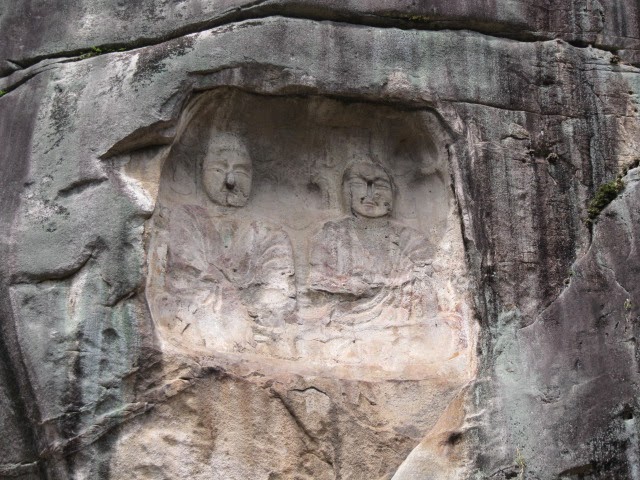
Going down from the top of a high mountain is fun... actually a little scary because you have to keep your hands on the breaks constantly for a long time. Some bikers fly down, but I prefer to keep my bike under controllable speeds, especially because my brakes are not exactly top of the line. As we were going down, we were lucky enough to stop to find this Buddhist carving on the side of a cliff. It is special because there are two Buddhas seated together.

Finally it was time to do the dredded big mountain. 5km continuously uphill. the bike lane looks like this. It's nice because there are many kilometer markers along the way so you know exactly how much further you have to go and how far you've come. It's also nice here because they seem to have little resting points every 500 m or so. It wasn't hard but extremely long. We took several breaks going up, but again, we managed without walking once.

Here were are at the top after 5km uphill. There was a little shop/restaurant up here, and we really enjoyed a little ice cream after the ride.

After tackling the big mountain it was all downhill from there. We couldn't help ourselves but to stop by this omija wine factory and get a glass of omija wine.
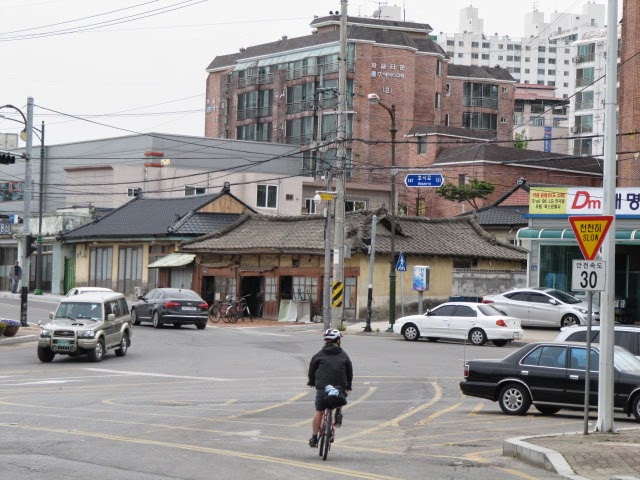
We finally had to stop for the night and we stayed near Munkyung in the city of Jeomchon (점촌). This happened to be the city where Halmoni lived and worked for many years after the Korean war. My husband was quite excited to finally see this city which was so important in his family history. We stayed the night here in a little love motel for 35,000/night.

The next day we decided that, since we had gotten too delayed on day one with all the bike problems that it would be impossible to get to Busan. So, instead we decided to follow our plan B, to head to Andong Dam.
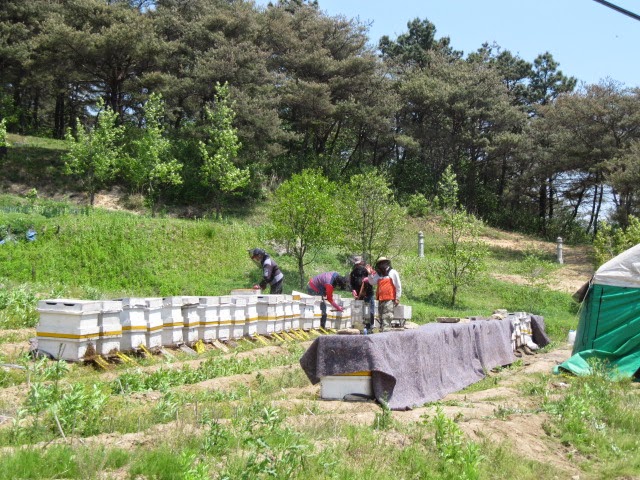
This is another bike path which follows the Nakdong river. It was also another fantastically beautiful path through the countryside. Though they call it a bike path, it's basically the little, rarely used country roads between the fields.

Finally we arrived in Andong. We were pretty exhausted so we found a love motel to share for the night. Since Andong is a big city, it was a bit more expencive than the other places we had stayed, 50,000, so we all stayed in one room. Dinner was Andong Jjimdak, of course. Then we got ice cream and went back and watched movies and passed out.

In the morning we continued on to Andong Dam (so close from where we were! Probably less than 5km! We should have just finished it the night before) and got our stamp. We explored the area a little, they had a nice natural area, plus an area with traditional houses which were saved, moved and preserved before creating the dam in the 70's.

Since it was Buddha's Birthday, we made sure to find a temple and get some bibimbap.

Our last stop before leaving Andong was visiting the Andong Soju museum. There we met a friendly man and my husband was able to ask all his soju brewing questions to (we have made soju at home several times now).

Finally it was time to go home. Being the last day of a long weekend, we were lucky to have gotten standing room only seats on the train. So you know, trains have some bike racks in the cafe car. We tried to get it on the regular car and not only would it have been impossible but they weren't very happy about it either, and sent us to the cafe car. Here we were lucky to have gotten on at the first stop and we got a seat on the floor in the cafe. As you can see, people who got on later didn't have that luxury. Though they also didn't have as far to go either. From Andong to Cheongnyangni station was about 3.5 hours. Not too bad, and no risk of traffic either since it was a train. I wouldn't mind taking the train again (especially if I got seats ahead of time!).
Overall it was a really fantastic trip, I look forward to the next bike trip! I hope there will be many more!
Wednesday, March 26, 2014
Indian Food
I'm pretty sure that Indian food is the best food in the world. I can't think of any cuisine which has quite as many flavors or diversity as Indian food. While I was in India, I spent most of my time in the Tibetan community, which meant getting Indian food was a bit of a production, however, I tried my best to get Indian food at least once a week while working at the monastery.


One of the most ubiquitous street foods in India are samosas. Who can resist deep fried amazingness?

Hindi sweets are quite famous. After watching this guy making these deep fried snacks I couldn't help but buy one to try. Actually, the taste reminds me a lot of the Korean pastry 약과 (yakgwa), but these are a lot prettier in their swirly shapes.

This one was from another roadside dhaba on the way back from Agra. Amazingly simple palak paneer, yet so delicious.

Another curry (can't remember which) from a small restaurant in Delhi. With a lassi on the side. mmmm...

This was like Indian fast food/ take out. All the food was pre-prepared. Just order, and they'll serve it over to you.

Here is a very typical Indian street food/ snack. This deep fried bread is called puri and is served up with some simple curry or yogurt sauce to dip in.

When visiting Indian restaurants before going to India, I always avoided butter chicken. Not sure why, maybe I thought it would be too rich or too fatty. But, butter chicken was one of the first dishes my co-workers ordered for us on our first Indian food outing. And, well, I realized what I had been missing all those years. Butter chicken is absolutely mouth-watering. Just melts in your mouth as you eat it. Definitely need to get this again soon.

Here is a man selling a variety of street food. The one in front is fried channa (chick peas), others are other random fried things. Well, there's a lot of deep fried and fried food in India...

This is the kind of street food that tourists should definitely not eat if they don't want to get sick. Basically fresh vegetables with chili sauce over some kind of crispy chip-like things. Tasty, but not recommended for tourists.

Here was our meal at the 'public dhaba' in Joginder Nagar. Channa masala, aloo palak, and mutton (goat) curry. Delicious and super cheap.

Here's another puri with various dipping sauces, plus a samosa at a popular hole in the wall restaurant in Baijnath.

Lots of samosas, puri and maybe those are parathas in a stack in the back. I'm still a bit confused about the difference between paratha, chapati, and roti... they all look like flat and round bread to me..


Here's another absolute tourist no-no which I should never have eaten. No idea what it was made of, but there was definitely cilantro and green onions mixed with some kind of spicy snack. It was being sold by a man roving bus to bus and he carried this around in a bucket and distributed it on recycled paper as you can see. I don't think this made me sick though

While in Palampur we decided to try out some more Hindi snacks. The yellow one was actually paneer (I think) in a cold creamy sauce. The orange one was actually made of carrots, but it was very tasty. After searching online, I found one dish called Gajar Halva.

This one is a pretty typical snack to eat while drinking in India. It's basically peanuts mixed with all sorts of fresh veggies. It's really nice, but again, I don't know the name of this dish.

Here's a pappadum with fresh vegetables on top. This is quite tasty. The pappadum is almost cracker-like in consistency so it's a little difficult to eat as it is very brittle, however with this veggie mix on top it's quite tasty.

I tried a few different biriyanis while in India. They were all really nice. Basically this is slightly creamy rice with many different spices.

Don't remember what this one was, something with paneer.

Here's an egg biriyani... really delicious...

Lots of amazing food...

Don't remember what this was... but I'm sure it tasted great...

Finally, my last breakfast in India. I was told I must try Paratha with curds as it is a very typical Himachal Pradesh breakfast food. Unfortunately, after several attempts (usually after breakfast time) I failed to find it in my town. So, on my last morning in Majnu ka Tilla in Delhi (the Tibetan colony in Delhi) I found paratha with curds on the menu at the Tibetan restaurant where we got breakfast and I figured it was my last chance to get it. Anyway, it was quite nice, the curds reminded me of my homemade yogurt actually and the bread was simple and nice to dip in the curds.
Before leaving India, I made sure to pick up a bunch of Indian spices. I hope I can use them soon to try making some Indian dishes!
This was one of my first meals in India. This was a roadside Dhaba (small restaurant) on the way to Agra. We were tempted to get this 'veg curry' because of the dirt cheap price of 20 rupees or something, however the bread was filled with something delicious which made one piece of bread about 100 rupees. So, not a dirt cheap meal, but still delicious and amazing. And made me more conscious of bread prices in future meals.
One of the most ubiquitous street foods in India are samosas. Who can resist deep fried amazingness?
Hindi sweets are quite famous. After watching this guy making these deep fried snacks I couldn't help but buy one to try. Actually, the taste reminds me a lot of the Korean pastry 약과 (yakgwa), but these are a lot prettier in their swirly shapes.
This one was from another roadside dhaba on the way back from Agra. Amazingly simple palak paneer, yet so delicious.
Another curry (can't remember which) from a small restaurant in Delhi. With a lassi on the side. mmmm...
This was like Indian fast food/ take out. All the food was pre-prepared. Just order, and they'll serve it over to you.
Here is a very typical Indian street food/ snack. This deep fried bread is called puri and is served up with some simple curry or yogurt sauce to dip in.
When visiting Indian restaurants before going to India, I always avoided butter chicken. Not sure why, maybe I thought it would be too rich or too fatty. But, butter chicken was one of the first dishes my co-workers ordered for us on our first Indian food outing. And, well, I realized what I had been missing all those years. Butter chicken is absolutely mouth-watering. Just melts in your mouth as you eat it. Definitely need to get this again soon.
Here is a man selling a variety of street food. The one in front is fried channa (chick peas), others are other random fried things. Well, there's a lot of deep fried and fried food in India...
This is the kind of street food that tourists should definitely not eat if they don't want to get sick. Basically fresh vegetables with chili sauce over some kind of crispy chip-like things. Tasty, but not recommended for tourists.
Here was our meal at the 'public dhaba' in Joginder Nagar. Channa masala, aloo palak, and mutton (goat) curry. Delicious and super cheap.
Here's another puri with various dipping sauces, plus a samosa at a popular hole in the wall restaurant in Baijnath.
Lots of samosas, puri and maybe those are parathas in a stack in the back. I'm still a bit confused about the difference between paratha, chapati, and roti... they all look like flat and round bread to me..
Making samosas
Here's another absolute tourist no-no which I should never have eaten. No idea what it was made of, but there was definitely cilantro and green onions mixed with some kind of spicy snack. It was being sold by a man roving bus to bus and he carried this around in a bucket and distributed it on recycled paper as you can see. I don't think this made me sick though
While in Palampur we decided to try out some more Hindi snacks. The yellow one was actually paneer (I think) in a cold creamy sauce. The orange one was actually made of carrots, but it was very tasty. After searching online, I found one dish called Gajar Halva.
This one is a pretty typical snack to eat while drinking in India. It's basically peanuts mixed with all sorts of fresh veggies. It's really nice, but again, I don't know the name of this dish.
Here's a pappadum with fresh vegetables on top. This is quite tasty. The pappadum is almost cracker-like in consistency so it's a little difficult to eat as it is very brittle, however with this veggie mix on top it's quite tasty.
I tried a few different biriyanis while in India. They were all really nice. Basically this is slightly creamy rice with many different spices.
Don't remember what this one was, something with paneer.
Here's an egg biriyani... really delicious...
Lots of amazing food...
Don't remember what this was... but I'm sure it tasted great...
Finally, my last breakfast in India. I was told I must try Paratha with curds as it is a very typical Himachal Pradesh breakfast food. Unfortunately, after several attempts (usually after breakfast time) I failed to find it in my town. So, on my last morning in Majnu ka Tilla in Delhi (the Tibetan colony in Delhi) I found paratha with curds on the menu at the Tibetan restaurant where we got breakfast and I figured it was my last chance to get it. Anyway, it was quite nice, the curds reminded me of my homemade yogurt actually and the bread was simple and nice to dip in the curds.
Before leaving India, I made sure to pick up a bunch of Indian spices. I hope I can use them soon to try making some Indian dishes!
Subscribe to:
Posts (Atom)